
The Pitch Is Simple. The Reality Is More Complicated.
No account. No KYC. No waiting. Just pick two coins, enter your wallet address, send your crypto, and receive the swapped amount on the other side. Usually in under thirty minutes.
That is the SimpleSwap promise — and for the overwhelming majority of transactions, it delivers exactly that. Coin Bureau, one of the most respected independent crypto research publications, updated their SimpleSwap review in March 2026 and concluded that yes, SimpleSwap is worth using in 2026 for simple wallet-to-wallet crypto swaps. That is not a marketing claim. That is an independent verdict from people whose credibility depends on getting these assessments right.
But the full story of SimpleSwap in 2026 is not only about the transactions that go smoothly. It is also about what happens when they do not — and those cases deserve honest, detailed examination before you send a single satoshi.
What SimpleSwap Actually Is — And What It Is Not
Most people encounter SimpleSwap through a friend’s recommendation or a Google search for no-KYC crypto swap. The interface looks clean, the process looks simple, and within minutes you have initiated your first exchange. What most people do not fully understand until something goes wrong is the structural reality of how SimpleSwap operates.
SimpleSwap is not a cryptocurrency exchange in the traditional sense. It does not operate its own order books or hold liquidity internally. It is what Coin Bureau’s 2026 analysis accurately describes as a non-custodial swap aggregator — a routing layer that sits between you and a network of external liquidity providers including Binance, Kraken, OKX, and others. When you initiate a swap on SimpleSwap, the platform finds the best available rate across its partner network and routes your transaction through one of those external venues. The exchanged coins then arrive at your specified wallet address.
This structure has important practical implications. SimpleSwap’s direct control over your transaction is limited to the routing decision. Once funds flow into the partner liquidity provider’s system, compliance decisions — including KYC requests, AML holds, and transaction freezes — are made by that external partner rather than by SimpleSwap alone. This is why SimpleSwap’s response to some compliance-related complaints references their liquidity providers acting independently — because in those cases, that is literally what is happening. Understanding this architecture does not excuse every negative outcome. But it explains why some disputes are more complex than they initially appear.
The Experience When Everything Works
The SimpleSwap experience for routine transactions is genuinely as frictionless as advertised.
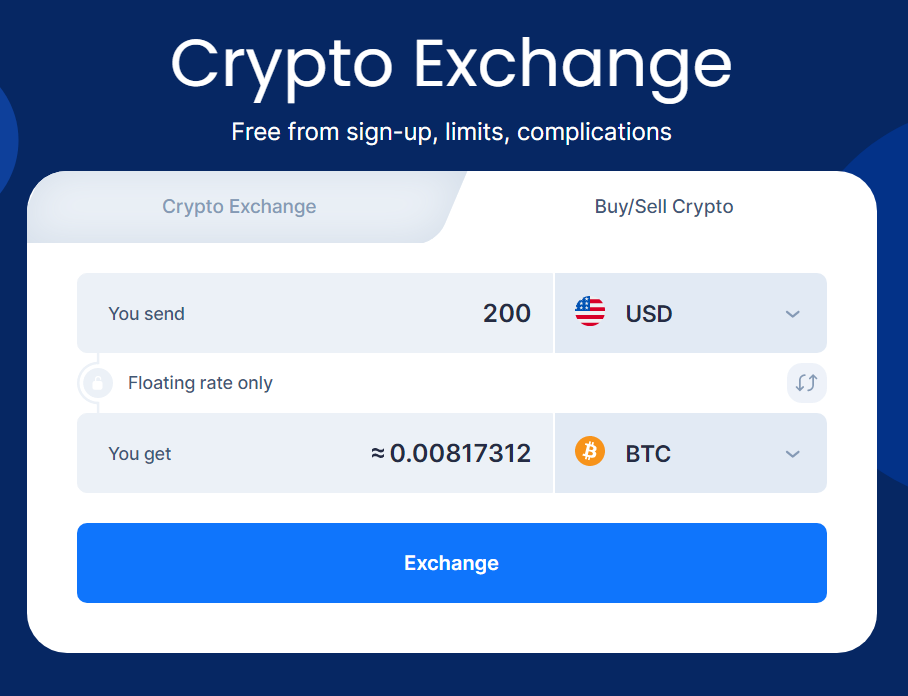
You navigate to simpleswap.io or open the mobile app. You select your source currency — say, Ethereum — and your destination currency — say, Bitcoin. You enter the amount. You see the estimated received amount in real time, with the choice between a floating rate that adjusts to market conditions at execution time and a fixed rate that locks the displayed quote for approximately fifteen minutes.
You enter your destination wallet address. You confirm the details. SimpleSwap generates a deposit address for the source currency. You send your crypto from your wallet to that address. SimpleSwap detects the incoming transaction, executes the exchange through its liquidity network, and sends the converted amount to your destination address.
Most transactions complete within five to thirty minutes. Network congestion on the blockchain being used can extend this — an Ethereum transaction during a period of high gas prices will be slower than the same transaction during quieter network conditions. This is not a SimpleSwap limitation. It is the nature of blockchain transactions.
One multi-year user described returning to SimpleSwap after a longer break and finding that everything worked flawlessly — noting that their most recent exchange completed without any issues whatsoever. Another described it as a godsend for New York State residents who face regulatory restrictions that make many standard exchanges inaccessible — SimpleSwap’s no-registration model being the only practical path to certain exchanges.
A user who made an error in their transfer — sending the wrong currency — described support handling the situation and issuing a full refund despite the user not even having a registered account. The ability to resolve a user-initiated mistake without an account relationship in place is a meaningful operational capability.
The 1,500+ Currency Library and the Pairs That Matter
SimpleSwap currently supports over 1,500 cryptocurrency and fiat currency pairs — one of the largest asset libraries available on any instant swap platform. Bitcoin, Ethereum, USDT, USDC, BNB, XRP, Solana, Monero, Litecoin, Dogecoin, Cardano, Polkadot, and hundreds of altcoins across major and minor blockchains are all available.
The Monero availability deserves specific mention because it is increasingly rare. As regulatory pressure on privacy coins intensifies globally, many platforms have delisted XMR entirely. SimpleSwap continues to support Monero swaps — a fact that makes the platform specifically valuable for users in jurisdictions like New York State where accessing privacy coin trading through compliant exchanges is essentially impossible.
Fiat-to-crypto purchasing via Visa and Mastercard is available through SimpleSwap’s partner Mercuryo. This allows users who hold no existing crypto to purchase Bitcoin, Ethereum, and other assets using a payment card. Card purchases do require identity verification through Mercuryo’s KYC process — this is a third-party payment processor requirement, not a SimpleSwap account requirement, but it is important to understand that the no-KYC positioning applies to crypto-to-crypto swaps rather than card purchases.
Fixed Rate vs Floating Rate: The Decision That Matters More Than You Think
The choice between fixed and floating rate is the most consequential decision a SimpleSwap user makes before initiating a transaction — and it is one that many first-time users do not fully understand.
The floating rate executes at the market price prevailing at the moment the incoming transaction is confirmed on the blockchain. Between the moment you initiate the swap and the moment it executes, the market can move. On liquid major pairs like BTC-ETH, this movement is typically small. On volatile altcoin pairs or during periods of broader market movement, the difference between your estimated amount and your received amount can be meaningful.
The fixed rate locks the displayed exchange rate for the duration of the quote window — typically fifteen minutes. If your transaction confirms within that window, you receive exactly the amount displayed at the time of initiation. If the window expires before your transaction confirms — which can happen during periods of blockchain congestion when transactions queue up — the rate must be refreshed.
SimpleSwap earns revenue through the spread between rates rather than an explicit commission. The fixed rate typically carries a slightly wider spread than the floating rate to compensate for the volatility risk SimpleSwap absorbs. For users who value certainty over theoretical optimization, the fixed rate is worth the marginally wider spread. For users who are comfortable with market rate execution, the floating rate is the default reasonable choice.
The Compliance Reality in 2026: What You Need to Know Before You Swap
This is the section that separates a useful review from an incomplete one — and it requires genuine honesty about a pattern that has become increasingly documented in SimpleSwap’s recent user feedback.
SimpleSwap was founded on a no-KYC promise. And for the majority of everyday transactions at typical retail sizes, that promise holds. You can swap without an account, without identity verification, and without providing personal data.
But the no-KYC promise has limits — and those limits have been applied with enough inconsistency to generate serious complaints from users who encountered them without warning.
The compliance trigger system works as follows: SimpleSwap’s own compliance monitoring and its liquidity providers’ AML systems analyze transactions for risk signals. When a transaction triggers a flag — which can occur due to transaction size, source wallet history, destination wallet classification, or algorithmic pattern matching — the exchange may be paused. At that point, the user is informed that KYC verification is required to either complete the exchange or receive a refund.
The most serious documented cases from 2025 and early 2026 follow a consistent pattern. A user sends funds. The exchange pauses for compliance review. The user is asked to complete KYC through a third-party service — SumSub or similar. The user complies, or refuses, or completes partial verification. Weeks pass. The funds remain held. The promised refund deadline passes without delivery. Support responses become slower, more generic, and more circular. The funds remain in limbo with no clear resolution timeline.
One user documented waiting over a month for a 6,600 USDT refund despite completing every verification request. Another documented 0.1 BTC being held for over 35 days — with the explanation shifting from technical issues to mandatory compliance check to we cannot provide an exact final date over successive support interactions. A third described sending $4,150 USD worth of crypto on February 26, 2026, and the funds not arriving as of the documentation date.
SimpleSwap’s responses to these cases on public platforms are consistent: they acknowledge the situation, they reference their AML obligations, they state they are working with their liquidity providers to resolve the case, and they invite the user to contact support. What the responses do not include is a credible timeline for resolution or a clear escalation path that gives affected users confidence their funds will be returned.
This is the fundamental risk of using SimpleSwap for any transaction of meaningful size. For routine small-to-medium swaps where the amount at stake is tolerable, the risk is manageable. For larger transactions where the funds represent a significant portion of your crypto holdings, the absence of a reliable, accountable resolution pathway for compliance-triggered holds is a risk that must be weighed seriously.
The Security Track Record: Where SimpleSwap Has Earned Credit
The compliance risk described above must be balanced against a genuine security achievement that rarely receives adequate coverage in SimpleSwap reviews.
During 2024, SimpleSwap actively collaborated with multiple cryptocurrency exchanges that had suffered security breaches — helping to identify, intercept, and recover stolen funds before they could be laundered through its platform. When Coins.ph suffered a security breach, SimpleSwap’s security team intercepted a transfer of 200,000 XRP and ensured the funds were returned. After CoinEx was hacked, SimpleSwap assisted in recovering approximately 11.8 BTC — approximately $780,000 at the time. In collaboration with CryptoForensic Investigators, SimpleSwap identified and halted fourteen transactions linked to a security breach at Remitano, preventing the loss of approximately $107,085.
This track record of active participation in industry security initiatives is not the profile of a platform that is indifferent to compliance. It reflects a compliance function that is genuinely operative — which makes the inconsistency of compliance hold resolution outcomes more puzzling rather than less. The platform clearly has the technical capability to monitor and intercept suspicious transactions. The gap appears to be in the customer-facing resolution process when those systems trigger false positives or unclear cases.
The Mobile App: Solid Performance, Limited Discovery
The SimpleSwap mobile app is available for both iOS and Android and has earned a 4.6 out of 5 rating on Google Play across a meaningful number of reviews. The app replicates the desktop experience faithfully — currency selection, rate comparison, fixed and floating mode, transaction initiation, and tracking are all available from your phone.
The app’s primary limitation is that most users discover SimpleSwap through desktop research and web search rather than through the App Store — meaning the app serves existing users more than it acquires new ones. For users who want to execute swaps on the go without a desktop browser, the app is capable and well-regarded. The mobile interface is clean, loads quickly, and handles the core swap workflow without the clutter that characterizes some competing crypto platforms.
Support access through the app received specific positive mentions from users who needed assistance during a transaction in progress — the ability to open a support chat from within the app without leaving the transaction view is a practical convenience that reflects thoughtful mobile UX design.
The Loyalty Program: Genuine Value for Frequent Users
SimpleSwap operates a BTC cashback loyalty program for users who create registered accounts — a significant addition given that basic swap functionality requires no registration whatsoever.
Registered users earn BTC cashback on every completed exchange, with the rate scaling based on cumulative exchange volume over time. An invite referral system provides additional cashback when referred users complete exchanges. An affiliate program offers revenue sharing of up to 90 percent for partners who integrate SimpleSwap into their own platforms or drive significant referral volume — a notably generous structure by industry standards.
The loyalty program represents a meaningful incentive to create a registered account for users who swap regularly — even though registration is never required for individual transactions. The privacy trade-off of creating an account in exchange for ongoing BTC rewards is a personal calculation each user must make, but the program’s generosity is genuine.
Comparing SimpleSwap Against Real Alternatives in 2026
The instant swap market has several credible competitors, and understanding where SimpleSwap fits relative to them is practically useful for buyers making a platform decision.
ChangeNOW operates a similar model with a smaller asset library — approximately 900 coins compared to SimpleSwap’s 1,500. Both are non-custodial and both have faced compliance-related hold complaints, though SimpleSwap’s volume of documented cases is proportionally larger relative to its user base.
Changelly has been operating since 2013 — longer than SimpleSwap — and has a similar rate-aggregation architecture. Changelly’s compliance trigger system has generated its own documented complaints. For users primarily concerned about compliance risk, neither platform offers a materially different risk profile, though SimpleSwap’s larger asset library is a genuine advantage for users needing access to less common pairs.
SideShift focuses on a more limited asset library — approximately 50 pairs — with a stronger no-KYC commitment at lower transaction sizes. For users whose primary concern is avoiding compliance triggers entirely, SideShift’s smaller scale and more conservative compliance model may offer a lower-risk profile for small transactions.
Decentralized exchanges — Uniswap, dYdX, and similar on-chain protocols — offer a genuinely different risk profile. With a DEX, there is no intermediary, no compliance function, and no possibility of a platform holding your funds pending AML review. The trade-offs are higher gas costs on congested networks, limited to on-chain assets, and higher technical complexity for users who are not familiar with wallet-to-wallet on-chain transaction mechanics.
| Feature | SimpleSwap | ChangeNOW | Changelly | SideShift |
|---|---|---|---|---|
| Asset Support | 1,500+ | 900+ | 500+ | 50+ |
| No Registration | Yes | Yes | Optional | Yes |
| Fixed Rate | Yes | Yes | Yes | No |
| Fiat Purchase | Yes | Yes | Yes | No |
| Mobile App | iOS + Android | Yes | Yes | Limited |
| Loyalty Program | BTC cashback | No | No | No |
| Compliance Hold Risk | Documented | Documented | Documented | Lower |
| Active Since | 2018 | 2017 | 2013 | 2020 |
The Practical Risk Framework: How to Use SimpleSwap Safely
Given everything documented above, here is the practical framework that experienced crypto users apply when using instant swap platforms including SimpleSwap.
For small transactions — amounts you could absorb losing without significant financial impact — SimpleSwap’s risk profile is entirely acceptable. The convenience, the asset library breadth, and the no-registration simplicity make it one of the best tools available for routine small-to-medium swaps.
For larger transactions — amounts that represent meaningful financial value — the calculus changes. Before using SimpleSwap for a large swap, consider whether the same outcome could be achieved through a regulated exchange where your funds are protected by a compliant, accountable institutional framework. The compliance hold risk documented above scales in severity with the amount at stake.
Use the fixed rate for large transactions where the certainty of the received amount matters more than optimizing the spread. The protection against slippage on a large transaction is worth the marginally wider fixed rate spread.
Use a payment method with buyer protection where applicable — credit card for fiat purchases provides chargeback rights that direct crypto transfers do not. This protection applies specifically to card-based fiat purchases rather than to crypto-to-crypto swaps, where transactions are irreversible by blockchain design.
Keep your transaction ID and all exchange correspondence. If a compliance hold is triggered, your ability to follow up effectively depends on having complete documentation of the transaction from initiation through any communications that follow.
Pros and Cons
Pros:
- Genuinely no registration required for crypto-to-crypto swaps
- 1,500+ assets — one of the broadest selection available on any instant swap platform
- Five to thirty minute typical completion time for routine transactions
- Clean, intuitive interface accessible to complete beginners
- Both fixed and floating rate modes available
- BTC cashback loyalty program for registered users — up to 90% revenue share for affiliates
- Mobile app rated 4.6 out of 5 on Google Play
- Active security collaboration with exchange hack recovery
- 24/7 support available in multiple languages
- Fiat-to-crypto card purchase available through Mercuryo partner
- Coin Bureau’s March 2026 independent review confirms the platform as worth using for its intended purpose
Cons:
- Compliance hold risk is real and documented — funds can be frozen without reliable resolution timelines
- KYC may be required retroactively for refunds on held transactions
- Registered in the Marshall Islands — limited regulatory accountability for dispute resolution
- Spread-based fee structure is less transparent than an explicit percentage commission
- Not suitable for large transactions where compliance trigger risk creates unacceptable financial exposure
- Transaction speed subject to blockchain congestion outside SimpleSwap’s control
- No advanced trading features — not designed for traders who need order books or limit orders
- Some support interactions described as slow and circular during complex compliance cases
Final Verdict
SimpleSwap in 2026 is exactly what Coin Bureau concluded it is: worth using for simple wallet-to-wallet crypto swaps where the goal is convenience, not lowest possible fees or maximum regulatory protection. For the routine swaps that represent the vast majority of transactions on the platform, it delivers a clean, fast, private experience that very few alternatives can match at its level of asset library breadth.
The compliance hold risk is the only genuinely serious caveat — and it is serious enough to shape how you use the platform rather than whether you use it at all. Treat SimpleSwap as a tool for routine convenience swaps. Treat large transactions with the full weight of the documented risk picture in this review.
Use it for what it is genuinely excellent at. Understand what it cannot guarantee when something goes wrong. And never send more than you could afford to have temporarily complicated — because complicated is the honest word for what some users have experienced, and it is a situation you want to enter with eyes open rather than optimism untested.
Final Score Summary
| Category | Score |
|---|---|
| Asset Library Breadth | ⭐⭐⭐⭐⭐ |
| No-Registration Privacy | ⭐⭐⭐⭐⭐ |
| Interface & Ease of Use | ⭐⭐⭐⭐⭐ |
| Transaction Speed | ⭐⭐⭐⭐ |
| Fixed/Floating Rate Options | ⭐⭐⭐⭐ |
| Mobile App Quality | ⭐⭐⭐⭐ |
| Loyalty & Affiliate Program | ⭐⭐⭐½ |
| Fee Transparency | ⭐⭐⭐ |
| Compliance Hold Risk | ⭐⭐ |
| Dispute Resolution Reliability | ⭐⭐ |
| OVERALL | ⭐⭐⭐⭐ |
⚠️ Disclaimer: Cryptocurrency involves significant financial risk. This review is for informational purposes only and does not constitute financial or investment advice. Always research thoroughly and never send more than you can afford to lose to any crypto exchange platform.