
Verdict: 4.3 / 5 — The Best Option Standing. Not Perfect. Still Your Move.
Let Me Tell You What This Actually Is
Forget the pitch decks. Forget the YouTube thumbnails with guys holding checks and wearing headsets in front of six monitors. Let’s strip this down to what Apex Trader Funding actually is at its core.
You pay a small fee. You get a simulated futures account with real market data. You trade it like real money. If you don’t blow the account past a set threshold, and you hit a profit target — they give you a funded account with actual capital behind it. You trade that, make profits, and they pay you.
That’s it. That’s the whole business model.
Apex Trader Funding has surged in popularity in 2026, offering a one-step evaluation requiring just 7 trading days to qualify, with a 100% profit split on the first $25,000 per account followed by 90/10 — among the most generous in the industry.
The real question isn’t whether the model makes sense. It does. The real question is: does Apex actually execute that model honestly? Does it pay? Does it play fair? Does it move the goalposts when money is on the line?
The answer in 2026, after a significant overhaul in March, is: mostly yes. With some important caveats that nobody putting a promo code in a YouTube description is going to tell you.
The 4.0 Reboot — Because the Old Apex Had Real Problems
Here’s something most Apex reviews in 2026 dance around rather than saying directly. The old version of Apex — the one running through late 2025 and early 2026 — had a reputation problem. And that reputation was earned.
The community was full of traders passing evals, doing everything right on paper, and then getting flagged for windfall behavior or gambling patterns. Apex had a reputation problem, and they knew it.
Rules that were unclear enough that traders violated them without realizing it. A payout review process that felt arbitrary. MAE warnings, 5:1 risk-reward mandates, one-direction restrictions — layers of complexity that created friction exactly where friction hurts most: at the point where a trader was about to get paid.
Then March 1, 2026 happened.
Apex released what they call 4.0. This isn’t a minor update. They rebuilt the product. The headline changes: one-time fees instead of monthly billing. EOD trailing drawdown as a real option. Automated payouts with no manual review process. No payout denials. Six rules eliminated entirely.
The new automated system has eliminated most of the frustrations traders had with the old manual review process. Payouts are approved in minutes, rules are enforced automatically so you cannot accidentally break them, and there are no more grey areas or misunderstandings. If you tried Apex before and had issues, it is worth giving them another look. The 2026 product is fundamentally different — and better.
That’s a candid assessment from someone who has tested it with real money. Automated enforcement means no human making judgment calls about whether your trade pattern looked like gambling. Either you broke the rule or you didn’t. Binary. Clean. Accountable.
The One Rule You Actually Need to Understand
People make Apex sound complicated. It isn’t. There is essentially one rule that matters during the evaluation phase.
Don’t let your account balance fall below the trailing drawdown threshold.
That’s it. That’s the whole evaluation in one sentence.
The EOD drawdown changes the feel of trading entirely. No more watching your threshold climb in real time while you hold a position. Close the session, drawdown recalculates overnight, next day you know exactly where you stand.
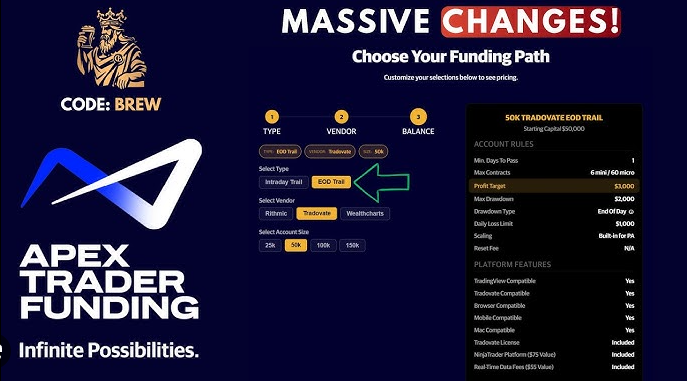
The choice between Intraday trailing and End-of-Day drawdown is the most important decision you make when setting up your account. Intraday trailing means the threshold rises as your unrealized profits move — which creates real-time pressure during open positions. EOD means the drawdown only recalculates at session close, giving you breathing room to let trades run without watching a moving floor undercut open positions.
Both paths allow for a 100% split of the first $25,000 and require a 5-day trading minimum, but they differ in risk enforcement. Intraday trails unrealized profit in real-time, while EOD calculates drawdown only at market close.
For traders who hold through intraday volatility — scalpers running tight stops who close positions before end of day — Intraday might suit their rhythm. For traders who take bigger swings and let positions breathe — the EOD model removes one significant source of forced stop-outs. Know which type of trader you are before you pick.
Once funded on a Performance Account, three conditions control your path to withdrawal. Five qualifying profitable trading days. The 50% consistency rule — no single day’s profits can exceed half your total profit for that payout cycle. And your account balance must stay above starting capital plus max drawdown plus a $100 buffer.
The 50% consistency rule: your single best trading day cannot account for more than 50% of your total profit at the time of the request.
This is the rule that trips people up most frequently, and it’s worth thinking through before you start a payout cycle. If you have one extraordinary day early in the cycle — a massive news trade, a perfectly timed breakout — that day’s profit will constrain when you can withdraw until subsequent trading days bring it below 50% of your cumulative total. The solution is not to avoid big wins. It’s to keep trading after big wins rather than immediately requesting a payout.
The Numbers Behind the Reputation
Let’s talk about the data that actually tells you whether Apex is real or theater.
Over $660 million paid out since 2022. $13 million average monthly in 2024–2025. Recent data shows $65 million in the last 90 days.
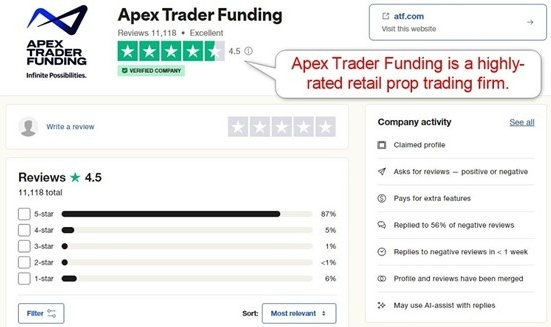
The Trustpilot rating sits at 4.4 out of 5, based on over 18,996 customer reviews.
Nearly 19,000 reviews across four years. $65 million in payouts in 90 days. These are not numbers a scam operation produces. They represent real traders getting real money into real bank accounts. The payout transparency — Apex posts every single payout publicly on their website — is unusual in this industry and meaningful. You can verify the numbers aren’t fabricated.
One Trustpilot reviewer who has been trading since April 2023 and received numerous payouts says: “It’s incredible to be able to copy up to 20 accounts at the same time and still receive 100% of the profits.”
Twenty accounts simultaneously. That’s not a footnote — that’s the scaling mechanism that makes Apex genuinely different from single-account prop firms. One community member trades up to 20 accounts at once to multiply his profits while limiting risk across any single account to avoid large drawdowns. When each funded account generates independent profits, running 10 or 20 of them in parallel is a legitimate income multiplication strategy — not a loophole, but an explicitly supported feature.
What It Actually Costs — The Full Story
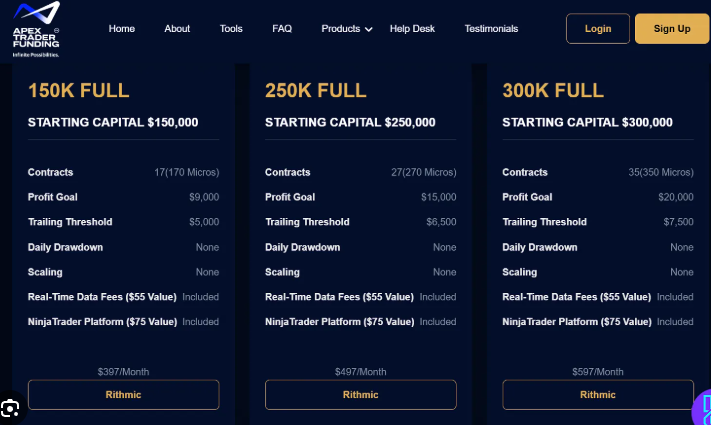
This is where Apex requires careful attention because the promotional marketing creates a gap between perceived and actual cost.
The sales cycle runs constantly. 70% off. 80% off. “Best deal of the year.” Every few weeks, a new promotion. A 50K account costs $145 total — $109 activation fee, $33 initial evaluation fee.
That $145 is the real number to work with for a $50K account. Not the $33 evaluation fee quoted in the headline. The activation fee hits after you pass the evaluation and are ready to receive your funded account. It’s a one-time charge, not recurring — but it’s real money that should be in your cost calculation from the start.
How does that compare to the competition? That’s more than other firms like Lucid and Tradeify, which currently offer flat fees without activation charges. Topstep is currently at a flat $95 with no activation fee.
The competitive pricing advantage Apex markets is real relative to full retail prices. Against newer competitors who have entered the market with cleaner fee structures, the advantage narrows. Shop the market honestly before committing.
The other cost variable is payout speed. Apex payouts are slower compared to newer firms like Lucid and Tradeify, which process in literally 15–30 minutes compared to Apex’s timeline. For traders who want near-instant withdrawal confirmation, the newer players have a genuine edge here. For traders who are fine waiting a day or two, Apex’s current automated system is adequate.
The Complaints That Are Actually Valid
Let’s be honest about what the negative reviews are really saying, because patterns in criticism tell you something important.
Three recurring complaint categories emerge from community analysis: payout delays with prolonged “Under Review” status on payout requests, rule enforcement where traders report accounts closed for minor technical breaches or disputed risk-management violations, and communication gaps — a recurring frustration being the perceived lack of transparency from the support team during compliance disputes.
The pattern in the negative reviews is important: more satisfied users tend to be disciplined traders who focus on long-term consistency. More critical feedback often comes from traders who may struggle with rule interpretation or automated compliance triggers.
This isn’t victim-blaming. It’s a structural observation. Apex’s rules are more mechanical and less forgiving than they appear in the promotional materials. Traders who approach the evaluation with the same discipline they’d apply to their own capital — measured position sizing, no revenge trading after drawdowns, no gambling on high-impact news events — generally get paid without drama. Traders who push the boundaries of the rules, even unintentionally, encounter enforcement that can feel harsh.
One legitimate concern is the inconsistent enforcement of rules around payouts. Multiple traders have reported meeting all stated requirements — only to have profits withheld due to vague or newly interpreted risk violations. This lack of transparency creates uncertainty.
The March 2026 automated enforcement system was specifically designed to address this. If you search online, you will find complaints about Apex payout rejections from the Legacy account era. The honest truth: most of those traders were violating rules — they just did not realize it. The old system had rules that were easy to accidentally break. The new system eliminates that ambiguity.
The honest verdict: under the new 4.0 system, rule interpretation disputes should be less common because enforcement is algorithmic rather than human. You either violated the rule or you didn’t, and the system flags it in real time rather than surfacing it during a payout review three weeks later.
The EOD vs Intraday Decision — Get This Right
This section deserves its own space because it’s the decision most traders underestimate.
Running two 100K EOD accounts under the new rules — passed both in the first week. The EOD drawdown changes the feel of trading entirely.
For context: on an Intraday trailing account, if you’re up $3,000 on the day and your trailing threshold has climbed accordingly, a sharp reversal that cuts your profit to $1,000 before you exit has permanently raised your floor by $3,000 — even though you only locked in $1,000. You’re managing a moving target in real time, through every tick.
EOD eliminates that intraday stress entirely. The floor only moves at session close based on your closed P&L. Hold a position through a 500-point NQ swing, close it flat, and your drawdown threshold hasn’t moved at all. That changes risk management psychology completely.
For discretionary traders who hold through noise and volatility — EOD. For systematic scalpers who open and close everything intraday with tight stops — Intraday might actually suit the rhythm better because the trailing mechanism follows quick profits upward without the lag of waiting for session close.
Know your trading style. Pick the account that matches it.
The 20-Account Reality Check
The 20-account capacity is Apex’s most powerful feature, and also the most overhyped one in the marketing ecosystem. Let’s be precise about what it means in practice.
Alex uses a Trade Copier to execute high-frequency scalps on the NQ across ten $150K accounts simultaneously. By spreading risk, he hit profit targets in the minimum 7 trading days.
Running 10 or 20 accounts with a trade copier amplifies both wins and losses uniformly. If your strategy has a genuine edge, multiplication works. If your strategy loses money, you lose money across 20 accounts simultaneously instead of one. The 20-account feature is a scaling tool for proven strategies, not a risk dilution mechanism.
John, a more cautious example of the patience model, took 42 days to reach his profit target on a $50K account — far beyond the old 30-day evaluation window. Because there’s no longer a maximum time limit, he took only high-probability setups. He’s now withdrawn over $12,000 in total profits.
That no-maximum-time-limit change is quietly one of the best updates in 4.0. The old 30-day evaluation window created artificial urgency that pushed traders into suboptimal trades near the deadline. Remove the deadline, and disciplined traders can wait indefinitely for their setups rather than forcing trades to beat a calendar.
The Real Competition Picture in 2026
Apex doesn’t operate in a vacuum. The futures prop firm space has become genuinely competitive, and being honest about how Apex stacks up matters.
The newer entrants — Lucid Trading, Tradeify, My Funded Futures — are faster on payouts, sometimes simpler on fee structure, and designed with the friction lessons from Apex and Topstep’s legacy problems baked into their product from day one.
Choose My Funded Futures if you want a streamlined, no-nonsense experience. Their one-step evaluation is arguably the most transparent for those who dislike the trailing drawdown complexity. It is an excellent middle ground for traders who find Apex too aggressive and Topstep too slow.
Apex’s advantages over these competitors are real but specific: the 20-account capacity is unmatched, the payout ceiling is higher than most firms, the brand track record across four years provides a certain confidence that a six-month-old firm cannot offer, and the community infrastructure — the Discord servers, the YouTube ecosystem, the shared knowledge base — is substantially deeper than what any newcomer has built yet.
With the old problems fixed and the new structure in place, bumping the rating to 4.3/5. The payout caps still hold it back from higher, and Intraday trailing is the same aggressive beast.
That’s a fair calibration. 4.3 — not perfect, not the runaway market leader it once was unchallenged, but a genuinely solid, well-run operation that has earned its reputation by paying out hundreds of millions of dollars to real traders over four years.
The Simple Decision Framework
You should try Apex if you trade futures specifically and only futures, your strategy is mechanical enough to be consistent across multiple accounts, you understand trailing drawdowns and can manage position size accordingly, you’re patient enough to wait for promotional pricing rather than paying full price, and you have at least 3–6 months of trading history that shows genuine edge rather than lucky streaks.
You should probably look elsewhere first if you’re brand new to trading and haven’t demonstrated consistent profitability anywhere yet, your trading style produces infrequent large wins rather than consistent smaller gains, you need near-instant payouts because you’re counting on the money immediately, or you want to trade forex, stocks, or options — Apex is futures only, full stop.
Final Word — From One Trader Perspective to Another
One long-time Apex trader put it well: “I’ve had ups and downs in my trading journey. I’ve bought lots of evals and PAs, and trial and error has brought me to a much better place. Apex has had changes along the way and I’ve made the adjustments. Thank you Apex for providing a platform to learn the lessons a trader needs to learn without the risk of ruining your life.”
That is the most honest summary of what Apex actually is for most traders. Not a get-funded-quick scheme. Not a passive income machine. A structured environment where the cost of learning trading lessons is capped at an evaluation fee rather than your life savings — and where, if you develop genuine consistency, the financial upside is real and verifiable.
The March 2026 overhaul removed the most legitimate criticisms of the old system. What remains are structural features — the 6-payout PA cycle, the activation fees, the payout speed relative to newer competitors — that are manageable rather than disqualifying.
$660 million paid out. Nearly 19,000 Trustpilot reviews at 4.4 stars. Automated payouts with no manual review. Twenty simultaneous funded accounts. No maximum evaluation time limit.
That’s the 2026 Apex. Decide accordingly.
⭐ The Scorecard — No Padding, No Pity Points
| What We’re Rating | Score | The Honest Note |
|---|---|---|
| Legitimacy & Track Record | 9.5/10 | $660M+ paid, 4 years, public payout records |
| Evaluation Clarity (post-4.0) | 9.0/10 | Binary rules, automated enforcement, no grey area |
| Payout Speed | 7.5/10 | Automated now, but newer firms are faster |
| Profit Split | 9.0/10 | 100% to $25K, 90% after — genuinely class-leading |
| Fee Transparency | 7.0/10 | Activation fee surprises people who don’t read carefully |
| Scalability (20 accounts) | 10/10 | Nothing else in the market touches this |
| Trading Platforms | 9.0/10 | Rithmic, Tradovate, WealthCharts — real infrastructure |
| EOD Drawdown Option | 9.0/10 | Game-changer for swing and positional traders |
| Customer Support | 6.5/10 | Adequate for routine issues, slow for complex disputes |
| Value vs Competition | 7.5/10 | Solid, but newer firms are competitive on price and speed |
| Overall | 🌟 4.3 / 5 | The benchmark. Not unchallenged. Still worth it. |
Trading futures involves substantial risk of loss. Prop firm evaluations are not guarantees of funding or profitability. Always read the full terms before purchasing any evaluation account. This review reflects information available as of May 2026.