

Overall Rating: 8.8 / 10 ⭐⭐⭐⭐
Most Crypto Investors Aren’t Losing Money Because of Bad Coins
They’re Losing Money Because They Don’t Know What They’re Doing
That sounds harsh.
But after spending time in crypto communities, one pattern appears repeatedly.
People obsess over:
- The next 100x coin
- The next bull market
- The next AI token
- The next meme coin
Yet many of those same investors can’t answer basic questions about their own portfolio.
Questions like:
- What’s your average Bitcoin cost basis?
- Which asset has generated the highest return?
- How much profit did you actually realize last year?
- How much exposure do you have to Ethereum ecosystem projects?
Most investors don’t know.
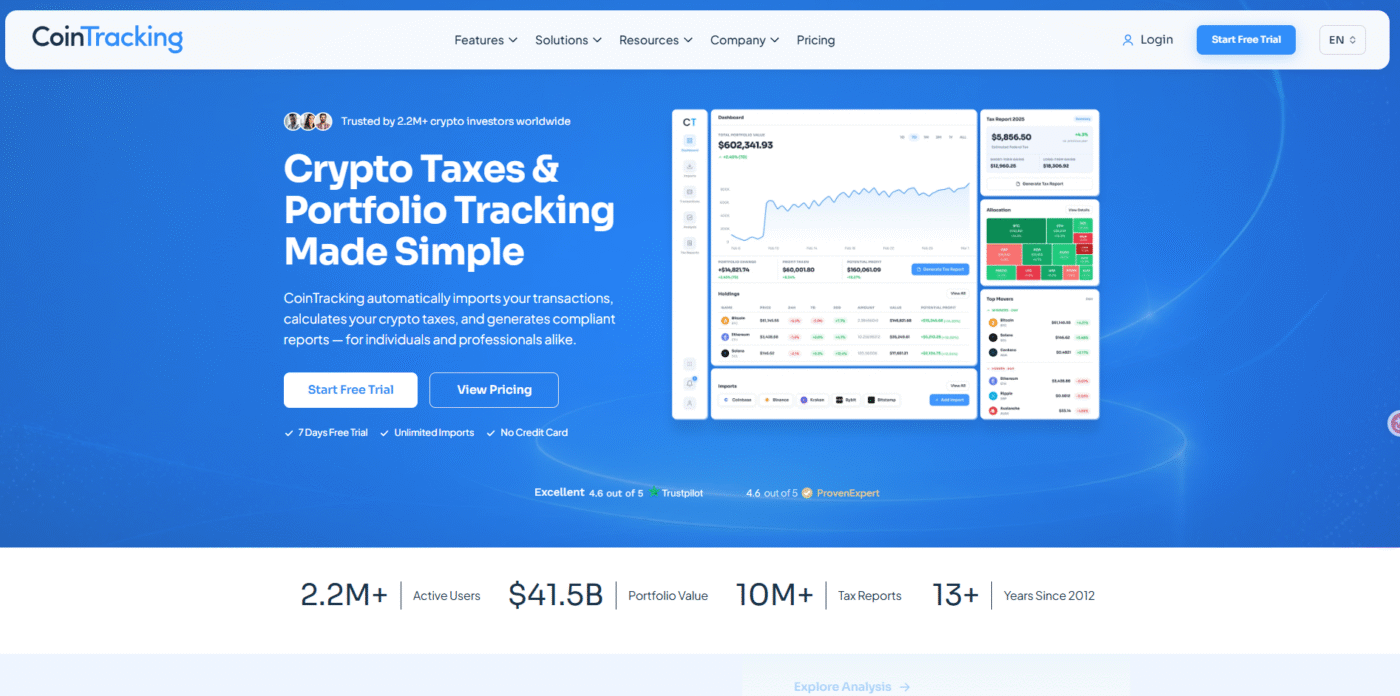
And that’s where CoinTracking becomes interesting.
At first glance, it looks like tax software.
In reality, it’s a visibility tool.
And visibility often leads to better decisions.
The question is whether those better decisions justify paying for another crypto subscription.
The Hidden Problem Every Growing Portfolio Creates
Crypto starts simple.
You buy a little Bitcoin.
Maybe some Ethereum.
A few months later things become messy.
You have:
- Three exchanges
- Two hardware wallets
- A staking platform
- Several DeFi positions
- Random token airdrops
- Forgotten altcoin purchases
Now your portfolio exists in pieces.
You know what each platform says.
You don’t know what your entire portfolio says.
That’s a dangerous position for any investor.
Because you can’t manage what you can’t see.
CoinTracking was built specifically to solve that problem.
What CoinTracking Actually Does
Most reviews immediately jump into tax reports.
I think that’s the wrong place to start.
The real value begins much earlier.
CoinTracking aggregates crypto activity from hundreds of exchanges and wallets into a single system.
Instead of logging into multiple platforms every day, you get one consolidated view.
That sounds simple.
It’s surprisingly powerful.
Because once everything exists in one place, analysis becomes possible.
And analysis is where money is either made or lost.
Feature #1: The Reality Check Most Investors Need
Portfolio Performance Tracking
One thing I noticed while testing CoinTracking is how often investors misunderstand their own performance.
A common example:
Someone buys a token at $1.
They buy more at $2.
They buy more at $4.
The token eventually trades at $3.
They think they’re losing money.
In reality, they may still be profitable.
Or the opposite happens.
Investors think they’re profitable when they’re actually underwater.
CoinTracking removes the guessing.
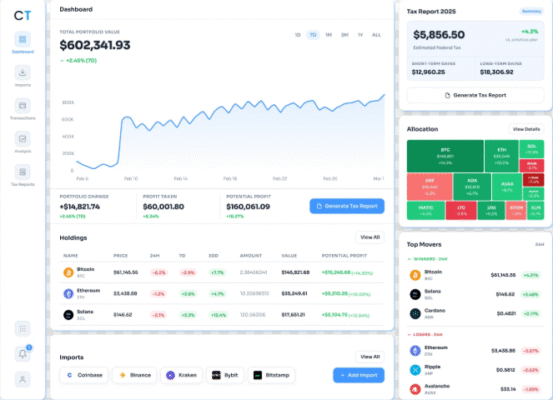
The platform calculates:
- Cost basis
- Realized gains
- Unrealized gains
- Asset performance
- Historical growth
The result is a much more accurate picture of reality.
And reality is usually better than assumptions when investing.
Feature #2: Discovering Where Your Money Actually Comes From
One of CoinTracking’s most useful reports surprised me.
Asset performance analysis.
Most investors believe they know which investments are generating returns.
Often they’re wrong.
Many users discover that:
- Their favorite project is underperforming
- A forgotten position is carrying the portfolio
- Staking rewards contribute more than expected
- Certain sectors consistently lose money
These insights aren’t exciting.
They’re valuable.
Because they help remove emotional decision-making.
Feature #3: Risk Becomes Easier to See
Risk management is one of crypto’s biggest weaknesses.
Most investors think about profits.
Few think about concentration.
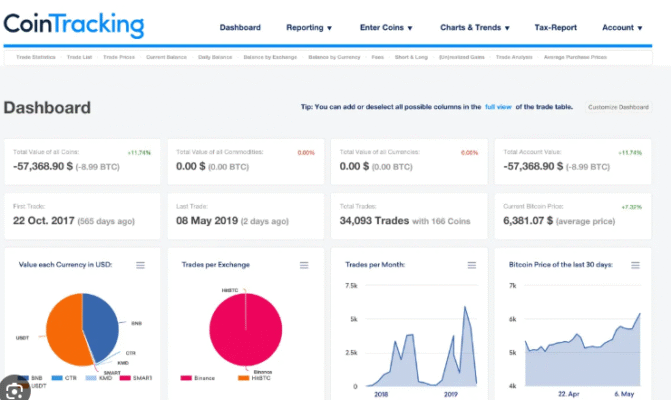
CoinTracking exposes portfolio allocation data that quickly reveals:
- Overexposure to a single token
- Excessive dependence on one ecosystem
- Lack of diversification
- Stablecoin allocation problems
The software doesn’t fix those problems.
But it makes them visible.
And visibility is the first step toward better risk management.
Why Active Traders Benefit the Most
If you only buy Bitcoin once every few months, CoinTracking may feel excessive.
The story changes dramatically for active traders.
Every trade creates:
- Profit opportunities
- Tax implications
- Portfolio adjustments
- Performance data
After hundreds or thousands of transactions, manually tracking everything becomes unrealistic.
This is where CoinTracking starts paying for itself.
Not because of tax savings.
Because of time savings.
Hours spent maintaining spreadsheets can instead be spent analyzing opportunities.
The Tax Features Are Still Excellent
Even though I don’t think taxes are CoinTracking’s biggest strength, they’re still a major reason people buy the platform.
The software supports:
- Capital gains calculations
- Income reporting
- Multiple accounting methods
- Country-specific tax reporting
For many users, tax season changes from:
“How do I even begin this?”
to
“Let me generate the report.”
That convenience alone is worth significant value for active investors.
Real-World Performance
After years in the market, CoinTracking has developed a reputation that feels remarkably consistent.
Power users love it.
Beginners often feel intimidated by it.
That reputation makes sense.
The platform wasn’t built for simplicity.
It was built for depth.
Users consistently praise:
- Reporting accuracy
- Analytics
- Portfolio visibility
- Exchange support
- Historical tracking
The biggest criticism remains usability.
The interface feels more like financial software than a modern consumer app.
Some investors appreciate that.
Others don’t.
Pricing Analysis
The easiest way to evaluate CoinTracking pricing is by transaction volume.
If You Have Fewer Than 100 Transactions
You probably don’t need a paid plan.
The free version may be enough.
If You Have Hundreds of Transactions
CoinTracking starts making financial sense.
The time savings alone become noticeable.
If You Have Thousands of Transactions
The software often becomes one of the cheapest tools in your investing stack relative to the value it provides.
Compared with competitors such as Koinly, CoinLedger, and CryptoTaxCalculator, CoinTracking remains competitively priced while offering deeper analytical capabilities.
Honest Limitations
1. The Interface Feels Like Enterprise Software
Functionality is excellent.
Design is not.
New users frequently feel overwhelmed.
Dealbreaker?
Not for data-driven investors.
2. Too Much Information for Casual Users
Some investors simply want:
- Portfolio value
- Tax reports
CoinTracking offers far more than that.
Many users never utilize most features.
Dealbreaker?
Potentially.
3. Automation Isn’t Perfect
Complex DeFi activity still requires verification.
Users should always review imported data.
Dealbreaker?
No.
But blind trust isn’t recommended.
4. Learning the Platform Takes Time
CoinTracking rewards effort.
The more you learn, the more valuable it becomes.
The downside is that onboarding isn’t as smooth as some competitors.
Dealbreaker?
Only if simplicity is your highest priority.
Competitive Comparison
CoinTracking vs Koinly
Choose Koinly if:
- User experience matters most.
- Simplicity is your goal.
Choose CoinTracking if:
- Analytics matter more than aesthetics.
CoinTracking vs CoinLedger
Choose CoinLedger if:
- You only care about tax filing.
Choose CoinTracking if:
- You want ongoing portfolio management.
CoinTracking vs CryptoTaxCalculator
Choose CryptoTaxCalculator if:
- You prioritize modern UI.
Choose CoinTracking if:
- You want more mature reporting tools.
Who Should Buy CoinTracking?
Ideal Buyers
- Active traders
- Multi-wallet investors
- DeFi participants
- Long-term crypto holders
- Data-driven investors
- Crypto accountants
Not Ideal For
- Complete beginners
- Casual Bitcoin holders
- Investors with minimal transaction volume
- Users seeking maximum simplicity
Final Verdict
Most people buy CoinTracking because they think they need help with taxes.
Ironically, the platform’s greatest value often has nothing to do with taxes.
Its greatest value is awareness.
When investors can finally see their portfolio clearly, they tend to make better decisions.
Better decisions don’t guarantee better returns.
But they usually improve the odds.
And in crypto, improving the odds is often one of the smartest investments you can make.
Detailed Scorecard
| Category | Score | Honest Assessment |
|---|---|---|
| Portfolio Visibility | 9.5/10 | Outstanding transparency |
| Analytics | 9.4/10 | Among the deepest available |
| Tax Reporting | 9.1/10 | Comprehensive and reliable |
| Exchange Integrations | 9.3/10 | Extensive support |
| DeFi Compatibility | 8.7/10 | Strong but not flawless |
| Ease of Use | 7.1/10 | Learning curve exists |
| User Interface | 7.0/10 | Functional rather than modern |
| Value for Active Traders | 9.3/10 | Easy to justify |
| Value for Casual Users | 7.5/10 | Often more than necessary |
| Overall Rating | 🌟 8.8 / 10 | A portfolio intelligence platform disguised as tax software |
Disclaimer
This review is for informational purposes only and does not constitute financial, investment, legal, or tax advice. Cryptocurrency investments involve significant risk, and investors should consult qualified professionals regarding tax compliance and financial planning.